Welcome to Bhutan
Step into the Last Shangri-La: a carbon-negative kingdom of mist-veiled cliffside monasteries, sacred fortress dzongs, prayer-draped valleys, and the philosophy of Gross National Happiness.
Discover the KingdomEnchanting Destinations of Bhutan
An in-depth travel companion exploring centuries-old Buddhist heritage, dramatic fortress architecture, high-altitude passes, and pristine alpine valleys.
 Crown Jewel & Sacred Icon
1. Paro: The Valley of Tiger's Nest & Timeless Dzongs
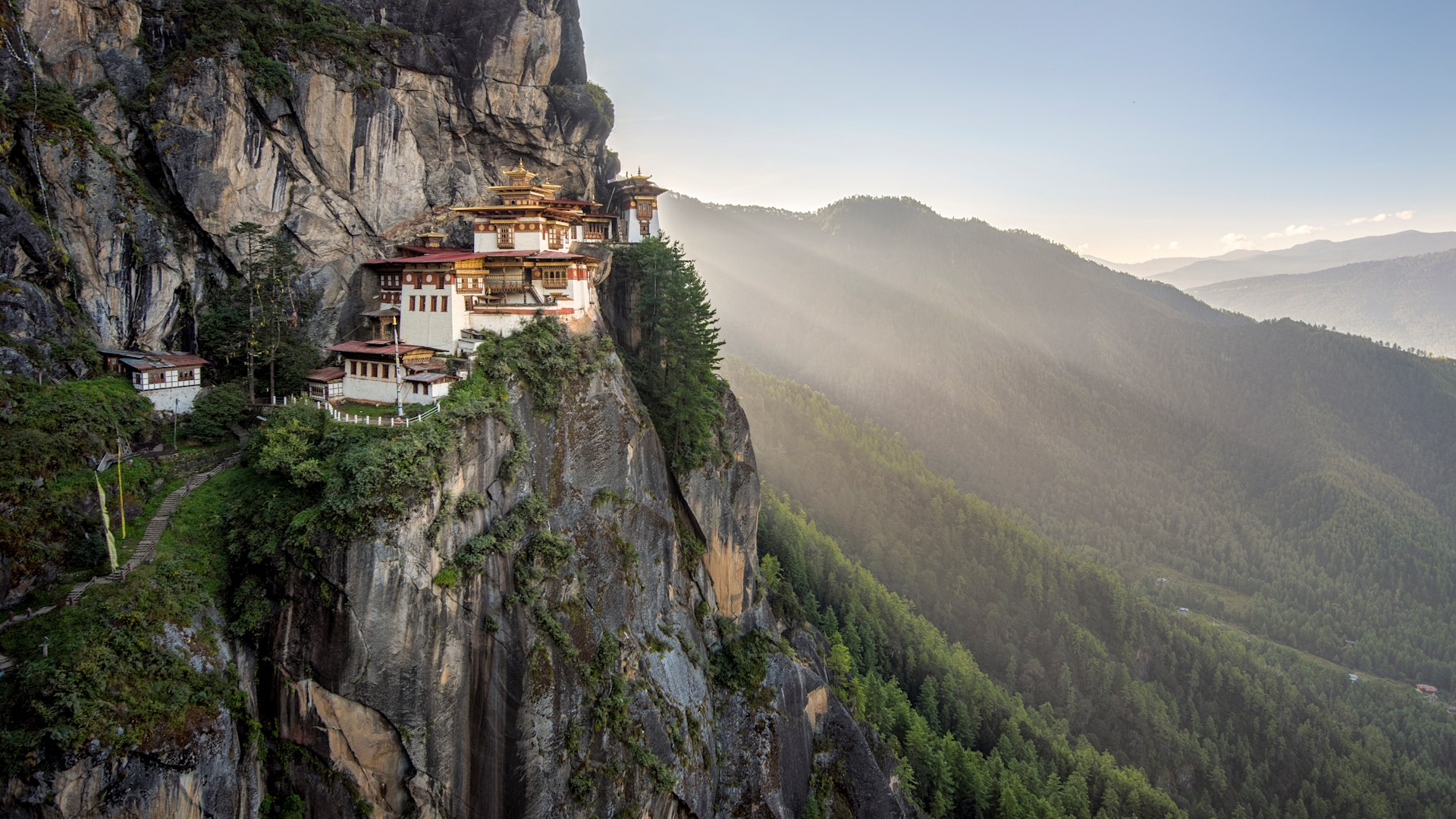
Perched precipitously on sheer granite cliffs above pine-scented valleys.
Spiritual Heritage & Cliffside Wonder
Paro is the picturesque western valley that welcomes international travelers arriving into the kingdom through its renowned alpine airport. Surrounded by emerald rice paddies and apple orchards, Paro is consecrated by the most famous landmark in the Himalayas: Paro Taktsang (The Tiger’s Nest Monastery). Clinging dramatically to a vertical cliff face 900 meters above the valley floor (3,120 meters above sea level), Taktsang is where Guru Padmasambhava (Guru Rinpoche) is believed to have flown on the back of a tigress in the 8th century to meditate in mountain caves and subdue local spirits.
The trek up to Tiger’s Nest winds through dense blue-pine woods adorned with fluttering multi-colored prayer flags. As hikers approach the cliff viewpoint, the mist parts to reveal white-washed fortress walls, gilded roofs, and hanging balconies that defy gravity. The sacred interior houses meditation caves, flickering butter lamps, and ancient wall frescoes that evoke deep quietude.
Key Attractions Across Paro Valley
- Rinpung Dzong (Paro Dzong): A massive fortress-monastery overlooking the Paro Chhu river, recognized for its massive wooden cantilever bridge (Nyamai Zam) and grand annual Tshechu festival.
- Ta Dzong (National Museum of Bhutan): A cylindrical former watchtower perched above Rinpung Dzong housing rare thangkas, festival masks, and Bhutanese weapons.
- Kyichu Lhakhang: One of the oldest 7th-century Himalayan temples built by Tibetan King Songtsen Gampo, revered for its sacred inner orange tree that bears fruit year-round.
 Royal Capital & Cultural Core
2. Thimphu: The Traffic-Light-Free Capital City
Where ancient monastic traditions seamlessly merge with modern royal governance.
The Unique Charm of Thimphu
Thimphu, nestled at 2,330 meters along the Wang Chhu river, holds the distinction of being the only national capital in the world with zero traffic lights. Instead, white-gloved traffic police direct vehicles from decorative traditional kiosks with synchronized elegance. The city gracefully harmonizes administrative modernity with royal decrees ensuring that all contemporary buildings adhere to traditional woodwork, sloped roofs, and Bhutanese architectural motifs.
High above the southern ridge overlooking Thimphu sits the monumental Buddha Dordenma (Kuenselphodrang). Standing 51.5 meters tall, this colossal bronze statue gilded in gold is one of the largest Buddha statues in the world. Inside its chest and lotus base dwell 125,000 miniature bronze Buddhas, radiating blessing across the entire valley.
Cultural Highlights & Living Traditions
- Tashichho Dzong: The "Fortress of the Glorious Religion," serving as the seat of the government and the summer residence of the Je Khenpo (Chief Abbot), illuminated beautifully along the river at night.
- National Memorial Chorten: A golden-spired Tibetan-style stupa where elderly citizens circumambulate continuously, turning brass prayer wheels and chanting mantras.
- Centenary Farmers Market & Zorig Chusum: Shop for dried yak cheese, red rice, and mountain chilies, and visit the national institute preserving Bhutan's 13 traditional arts and crafts.
- Motithang Takin Preserve: Encounter Bhutan's national animal, the Takin—a unique, docile herbivore that resembles a cross between a goat and a cow.
 Ancient Winter Capital
3. Punakha: The Majestic Palace of Great Happiness
Riverside fortress splendor, jacaranda blossoms, and fertile valleys.
Subtropical Grandeur & Royal Legacy
Located at a significantly warmer, lower altitude of 1,200 meters, Punakha served as the winter seat of Bhutanese monarchs and spiritual leaders for centuries. The valley’s centerpiece is the internationally acclaimed Punakha Dzong (Pungtang Dechen Photrang Dzong), widely considered the most magnificent fortress in the entire kingdom.
Constructed in 1637 by Zhabdrung Ngawang Namgyal, Punakha Dzong sits strategically at the confluence of two rushing glacial rivers: the Pho Chhu ("Father River") and Mo Chhu ("Mother River"). In springtime, brilliant lilac jacaranda blossoms canopy the white-washed river ramparts, creating an iconic postcard panorama. It remains the spiritual site where all Bhutanese kings are crowned and where the royal wedding of King Jigme Khesar Namgyel Wangchuck took place.
Valley Adventures & Unique Heritage
- Punakha Suspension Bridge: One of the longest suspension bridges in Bhutan, spanning 160 meters across the Po Chhu, draped in colorful prayer flags with thrilling valley views.
- Chimi Lhakhang (The Fertility Temple): A scenic walk across rice fields leads to this 15th-century temple blessed by the "Divine Madman" Lama Drukpa Kunley, sought out by couples from all over the world seeking fertility blessings.
- Khamsum Yulley Namgyal Chorten: A four-storey pagoda-style chorten standing atop a hillside ridge, offering breathtaking views over the sinuous terraced valleys of Punakha.
 Valley of the Black-Necked Cranes
4. Phobjikha Valley: Glacial Serenity & Endangered Cranes
Vast high-altitude peat bogs, dwarf bamboo meadows, and sacred avian migrations.
A Pristine Glacial Sanctuary
Phobjikha (also known as Gangtey) is a vast U-shaped glacial valley located at 3,000 meters on the western slopes of the Black Mountains. Unlike Bhutan’s narrow river gorges, Phobjikha opens wide into rolling marshlands, meadows of dwarf bamboo, and silent pine forests. To protect the peaceful valley ecosystem and endangered wildlife, power lines have been placed underground to preserve bird flight paths.
Every late autumn, the valley becomes the winter sanctuary for hundreds of globally endangered Black-Necked Cranes migrating from the Tibetan Plateau. According to local folklore, these majestic cranes circle the historic 17th-century Gangtey Goempa monastery three times upon their arrival in October and three times before their return journey in early spring, as if paying homage to the sacred shrine.
Eco-Trek Trails & Cultural Highlights
- Gangtey Nature Trail: A gentle, scenic 5-kilometer hike starting from Gangtey Monastery, meandering down through flower-strewn meadows and pine forests to the valley floor.
- Black-Necked Crane Information Center: Features high-power spotting scopes to view the cranes roosting in the marshlands, alongside conservation exhibits.
- Authentic Farmhouse Stays: Warm up beside a traditional *Bukhari* (wood-burning stove) and taste locally made butter tea (*Suja*) and *Ema Datshi* (chili and yak cheese).
 High Alpine Gateway & 108 Chortens
5. Dochula Pass: The 108 Memorial Chortens on the Mountain Ridge
Where misty alpine clouds part to reveal the snow peaks of the Eastern Himalayas.
The Epic Crossroads Between Thimphu and Punakha
Situated at an elevation of 3,100 meters along the national highway between Thimphu and Punakha, Dochula Pass is celebrated as one of the most visually stunning high-altitude mountain passes in South Asia. On crisp winter and autumn mornings, travelers are treated to a sensational 360-degree panoramic vista of the snow-crested Eastern Himalayan range, including Gangkhar Puensum (7,570 meters)—the highest unclimbed mountain in the world.
The pass is made unforgettable by the Druk Wangyal Chortens: a breathtaking cluster of 108 memorial stupas built on a natural grassy hillock by Her Majesty the Queen Mother Ashi Dorji Wangmo Wangchuck to honor the brave Bhutanese soldiers and celebrate peace in the kingdom.
Highlights & Natural Wonders
- 108 Memorial Chortens: Built in concentric tiers with red and white stone, standing resilient against drifting clouds and snow.
- Druk Wangyal Lhakhang: A temple perched atop the pass whose vibrant wall paintings uniquely depict contemporary royal history alongside traditional Buddhist iconography.
- Rhododendron Botanical Garden: Surrounding slopes erupt in crimson, pink, and white blossoms throughout April and May.